The Grand Budapest Hotel color palette: how to get the look.
Wes Anderson's The Grand Budapest Hotel (2014) is the film most people picture when they think of the Wes Anderson look: a pink hotel, purple uniforms, candy-colored pastry boxes and perfectly symmetrical frames. This guide explains how the palette was built, the color grading behind it, and how to get the look on your own footage with a free LUT.
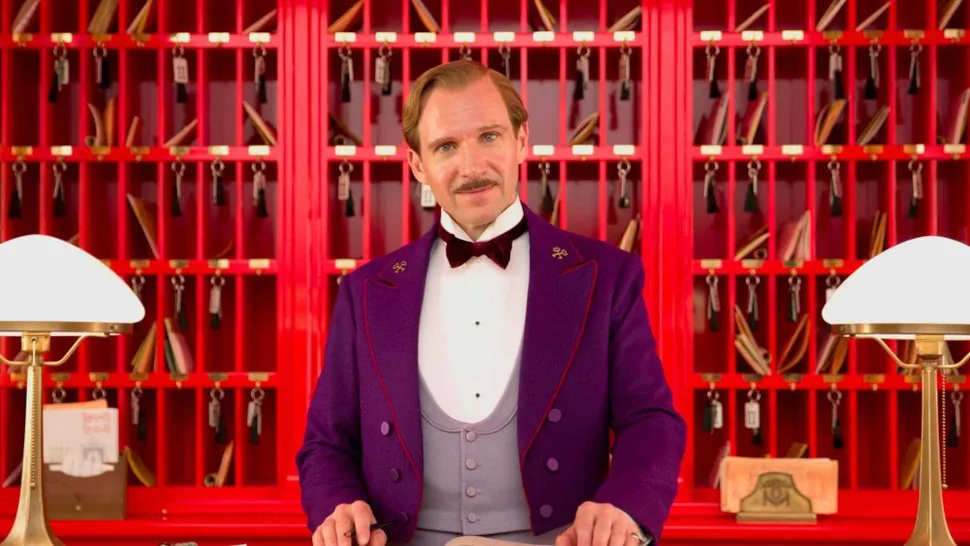
Ralph Fiennes as M. Gustave in The Grand Budapest Hotel (2014). Purple against saturated red, framed dead center between two matching lamps, sums up the Wes Anderson look about as well as any frame could. Image: Fox Searchlight Pictures.
Why The Grand Budapest Hotel looks like a pastry box.
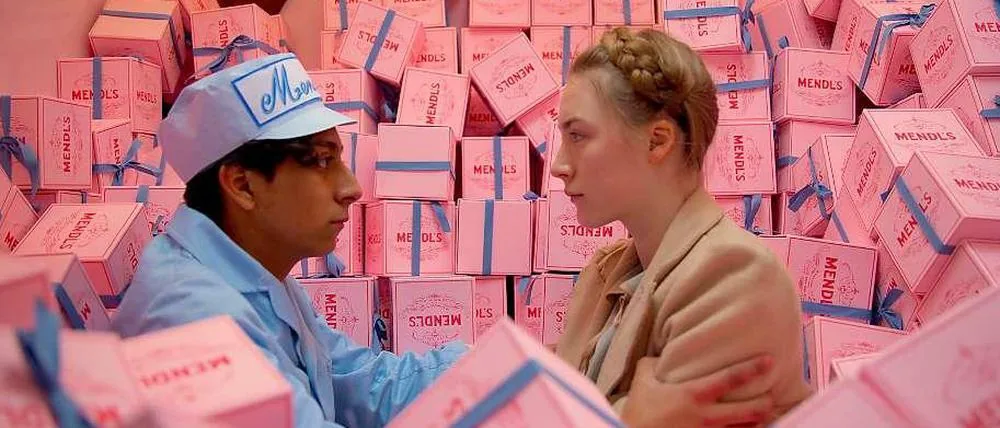
The Grand Budapest Hotel is built on a controlled pastel palette. The 1930s hotel is a pink and lavender confection, the lobby boys wear deep purple, and Mendl's pastry boxes are pale pink with blue ribbon. Reds and magentas are strong but never harsh, and contrast is soft enough that the image feels like an illustration.
The film also changes palette with time. The 1960s hotel, in decline, turns to tired oranges, browns and greens, while the 1930s story is all pinks and purples. That shift is why the film comes up so often in conversations about color storytelling, and it's what people are usually after when they search for the Wes Anderson color palette.
Tony Revolori and Saoirse Ronan as Zero and Agatha among Mendl's pastry boxes. Soft pink and powder blue fill almost the entire frame, and there's barely anything else in the frame. Image: Fox Searchlight Pictures.
Hotel pink
#E3A5B4
Lobby boy purple
#5B2A6E
Mendl's blue
#9FC2D6
Lavender
#B8A3CC
Velvet red
#9E2A33
1960s orange
#C77A3A
Approximate palette sampled by eye for reference. These are not official values from the film.
Behind the camera
Wes Anderson, Robert Yeoman and a palette built on set.
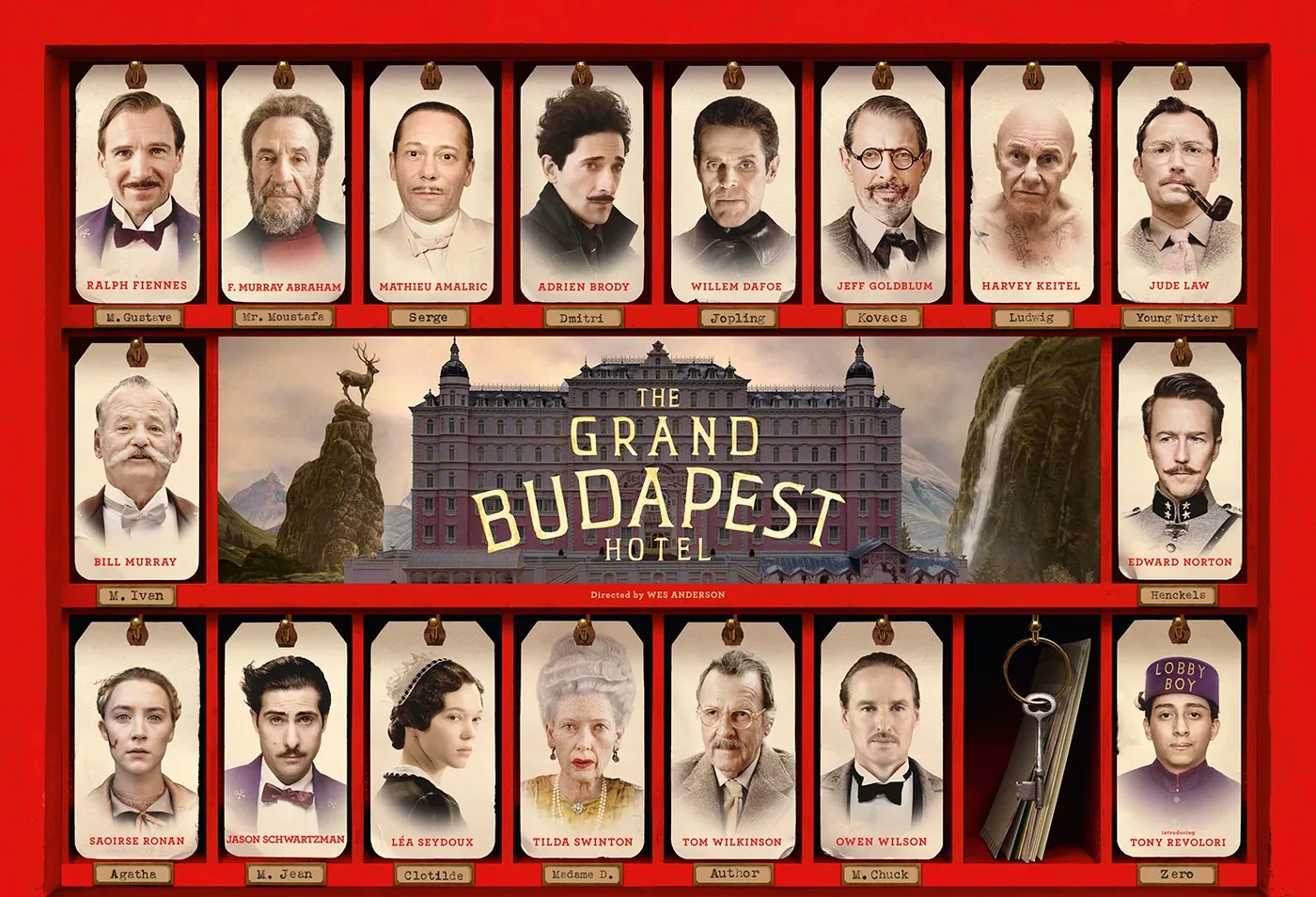
The film's cast poster arranges the ensemble, including Ralph Fiennes, Bill Murray, Saoirse Ronan, Adrien Brody, Willem Dafoe, Tilda Swinton, Jude Law and Tony Revolori, like keys on a hotel rack around the pink hotel. Image: Fox Searchlight Pictures.
Wes Anderson and his team
The Grand Budapest Hotel was written and directed by Wes Anderson and shot by Robert Yeoman, his cinematographer since Bottle Rocket, who was nominated for the Academy Award for it. Ralph Fiennes stars as the concierge M. Gustave, with Tony Revolori as Zero, Saoirse Ronan, Adrien Brody, Willem Dafoe, Tilda Swinton, Edward Norton, Jeff Goldblum, Jude Law and Wes Anderson regulars Bill Murray, Owen Wilson and Jason Schwartzman.
The color comes from the set
Most of the Wes Anderson look is decided before the camera rolls. Production designer Adam Stockhausen and costume designer Milena Canonero both won Academy Awards for the film, and their sets and costumes carry the pinks, purples and reds. The grade mainly keeps those colors soft and consistent. So a pastel LUT on its own will only take you part of the way.
Three eras, three aspect ratios
Anderson shot the film on 35mm and framed each time period in a different aspect ratio: the nearly square 1.37:1 for the 1930s, widescreen 2.35:1 for the 1960s, and 1.85:1 for the 1980s and present day. The shape of the frame tells you the era as clearly as the color.
A German department store as the hotel
The hotel lobby was built inside a historic department store in Görlitz, Germany, and the famous pink exterior shots used a detailed miniature model. The stylized, slightly artificial look is fully intentional.
Scene by scene
The key looks in The Grand Budapest Hotel.
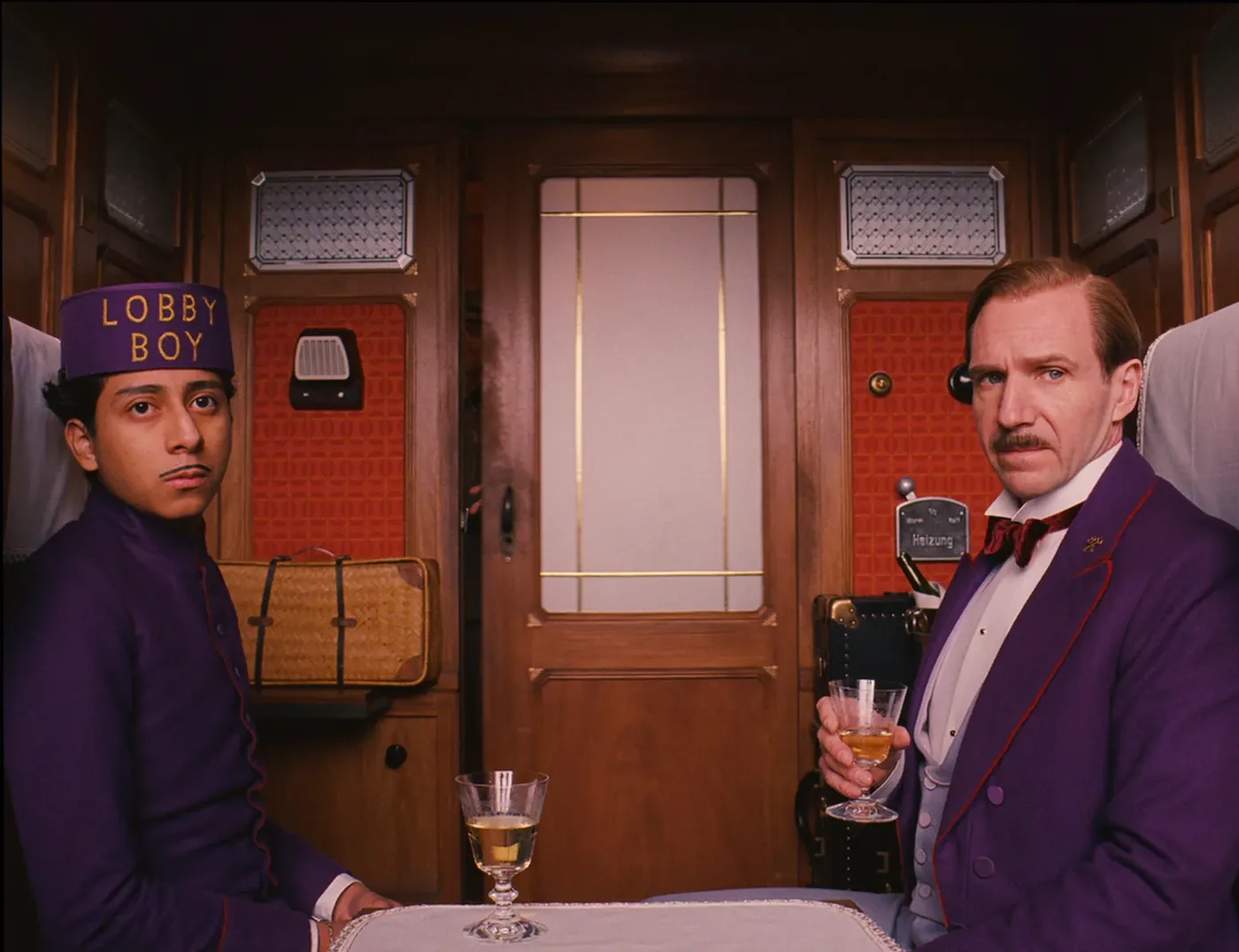
Zero and M. Gustave on the train, framed with perfect symmetry. The lobby boy purple, orange panels and warm wood show how one deep color holds a Wes Anderson composition together. Image: Fox Searchlight Pictures.
The pink hotel
The 1930s hotel exterior is a pastel pink wedding cake on a snowy hill. It's the image most people mean when they search for the Grand Budapest Hotel color palette.
Lobby boys in purple
Zero and the other lobby boys wear saturated purple uniforms with gold details, which stand out against the pink and red interiors.
Mendl's pastries
The pink pastry boxes with pale blue ribbon are a tiny color study of the film: soft pink with powder blue.
The 1960s in decline
The same hotel in the 1960s has orange, brown and mustard tones, worn carpets and dim light. It feels faded compared with the candy colors of its past.
Snow and the escape
Winter scenes, the prison break and the chase on the mountain use white snow with small, strong accents of color, giving the film a storybook quality.
Get the look
How to get the Grand Budapest Hotel look with a free LUT.
Most of the Grand Budapest look was built by the production designer and the costume department, so no LUT can hand it to you. A soft, warm pastel grade gets your footage into the right range, and the steps below add the pinks and purples, the soft contrast and the composition that make it feel like Wes Anderson.
Free starting point
Pastel LUT (VEL_Warm_Pastel.cube)
The best base for the 1930s look. It lifts the blacks, softens contrast and adds a gentle warm pink tint, which is the foundation of the Grand Budapest palette.
This lightens and softens the image and adds warmth to the pinks. Start here for any Grand Budapest style shot.
2. Push the pinks and magentas
With hue-vs-hue or HSL, shift oranges and reds slightly toward pink and raise their saturation a touch. Anderson's reds lean toward raspberry and rose. Fire-engine red would feel wrong here.
3. Turn the blues powder blue
Lower the saturation of blues and raise their brightness. Skies, ribbons and walls should end up looking like pale icing.
4. Make the purple the one deep color
If there is purple in your frame, keep it saturated and dark while everything else stays soft. Like the lobby boy uniforms, one strong color holds the composition together.
5. Try a 1.37:1 crop
Crop your edit to the nearly square 1.37:1 frame for a 1930s Grand Budapest feel, or keep widescreen for the 1960s scenes.
6. For 1960s scenes, switch to Vintage Film
Use the Vintage Film LUT at around 60%, lower the saturation of pinks and purples, and warm the image toward orange and brown.
Shooting for the Wes Anderson look.
Plan the palette before you shoot
Pick three or four colors for the whole scene and choose clothing, props and walls in those colors. In this style the color comes from the set, and the grade only polishes it.
Center everything
Place your subject in the middle of the frame and line up doors, windows and walls with the frame edges. Symmetry is half of the Wes Anderson look.
Shoot flat and frontal
Face walls and subjects straight on, and keep the light soft and even. Flat staging makes the frame look like a diorama.
Use quick pans and tableau shots
Anderson almost never goes handheld. The camera moves between composed frames with precise pans and tilts. Locking off the camera and panning on a tripod gets you close.
✦ Master Grade LUT Collection
Love a pastel palette?
Pink walls, purple uniforms and soft cream skies. The Pink, Vintage and Fashion categories in the Master Grade Collection give you far more to play with than one free Pastel LUT, and the Studio looks keep interiors clean.
Soft pink, lavender, deep lobby boy purple, powder blue and velvet red for the 1930s scenes, and faded orange, brown and mustard for the 1960s scenes.
Who was the cinematographer of The Grand Budapest Hotel?
Robert Yeoman, Wes Anderson's longtime director of photography, who was nominated for the Academy Award for Best Cinematography for the film.
Was The Grand Budapest Hotel shot on film?
Yes, it was shot on 35mm film, with a different aspect ratio for each time period.
Is there a free Wes Anderson LUT?
Not an official one, no. Start with the free Pastel LUT at 60 to 80%, then push pinks and soften blues as described above.
How do I get the Wes Anderson look in my videos?
Plan a limited pastel palette on set, center and frame everything symmetrically, shoot flat and frontal, then grade with a soft pastel look. The framing matters as much as the color.
Where was The Grand Budapest Hotel filmed?
Largely in Görlitz, Germany, where a historic department store became the hotel lobby. The exterior was a detailed miniature.
This guide describes the look of The Grand Budapest Hotel for educational purposes. VideoEditingLUTs isn't affiliated with or endorsed by Wes Anderson, Fox Searchlight Pictures or the filmmakers. The free LUTs we recommend here are our own general looks, and none of them were made from the film itself.
Free Download
12 free LUTs. Every look covered.
Professional .cube files. Free, no credit card. Browse every style: