The Odyssey color grading: how to get the IMAX film look.
Christopher Nolan's The Odyssey (2026) is the first feature shot entirely on IMAX film cameras, and its look comes almost completely from the film stock and the lab. Here's how Nolan and cinematographer Hoyte van Hoytema shot and color timed it, what that does to the image, and how to get close to it on digital footage with a free LUT.
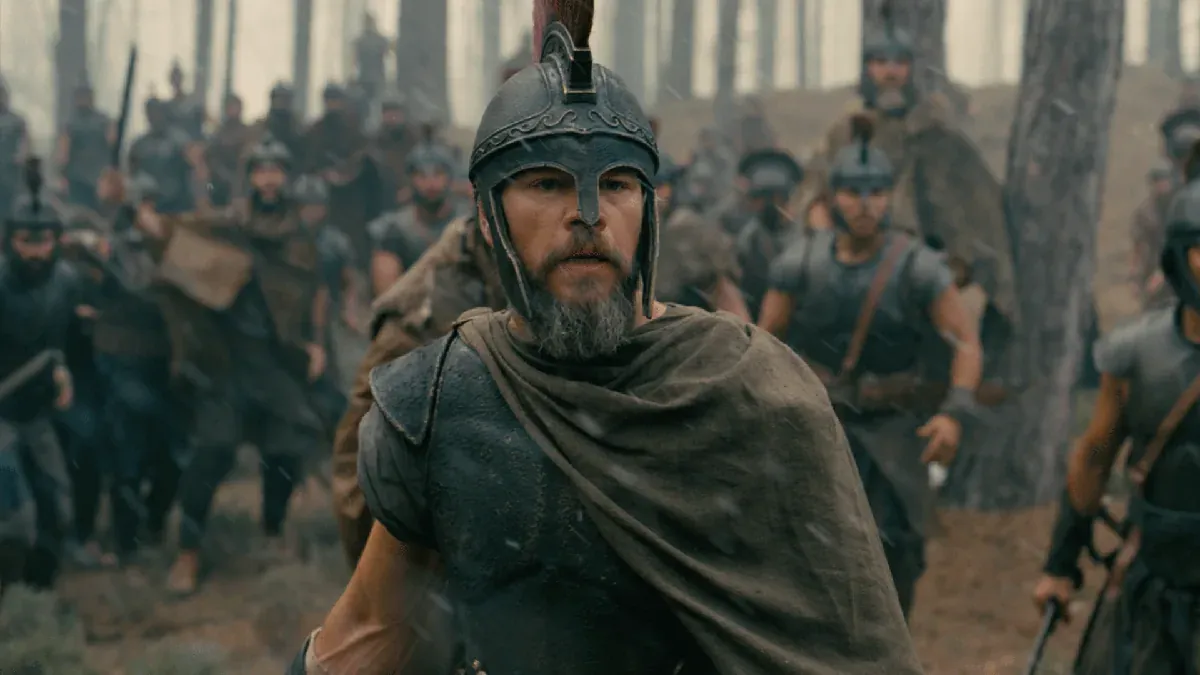
Matt Damon as Odysseus in The Odyssey (2026). Grey-green haze, dull bronze and wet wool. The daylight scenes are muted and natural, with nothing pushed toward teal or orange. Image: Universal Pictures.
The Odyssey doesn't have a loud color grade. Daylight scenes are muted and natural: grey-green forests, hazy skies, bronze armor that looks dull and heavy, and skin that stays warm without turning orange. Contrast is moderate, and highlights roll off softly into white the way film negative handles bright light.
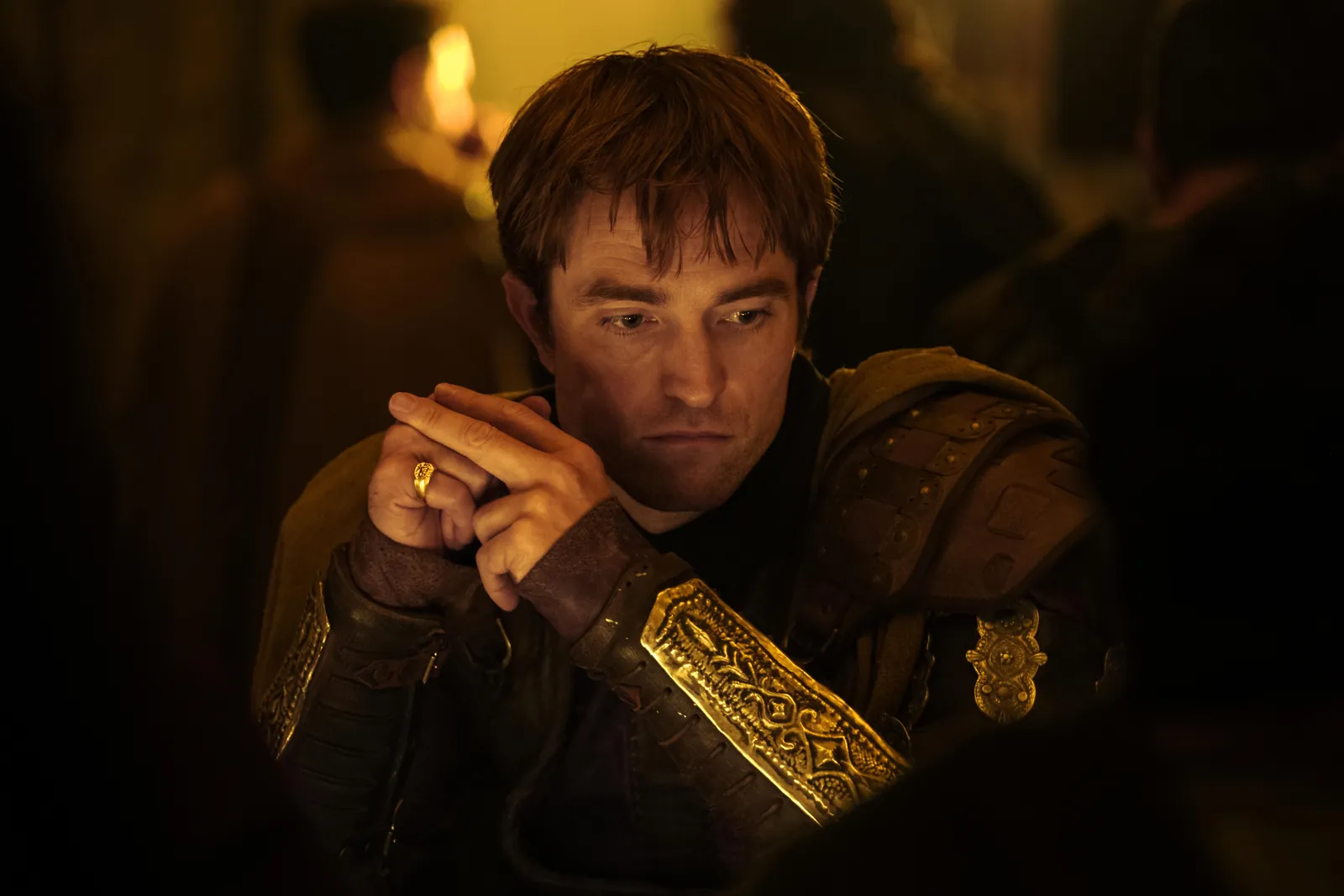
The strongest color comes from fire. Interiors and night scenes are lit by warm, flickering sources, so faces glow amber, gold and bronze catch the light, and the rest of the frame drops into deep, inky shadow. At dusk the cool blue of the sky meets the orange of torches and braziers. That warm and cool contrast comes from real light on set, then gets held together by fine film grain and a photochemical print finish.
Robert Pattinson as Antinous. One warm source, skin glowing amber, gold catching the light and everything else falling into near black. This is what 500T film does with firelight. Image: Universal Pictures.
Firelight amber
#D9A441
Skin in firelight
#96502A
Bronze
#73480D
Ember orange
#F7621B
Forest haze
#62625D
Dusk slate
#4A6B82
Approximate palette sampled by eye for reference. These are not official values from the film.
Behind the camera
Christopher Nolan, Hoyte van Hoytema and 2 million feet of film.
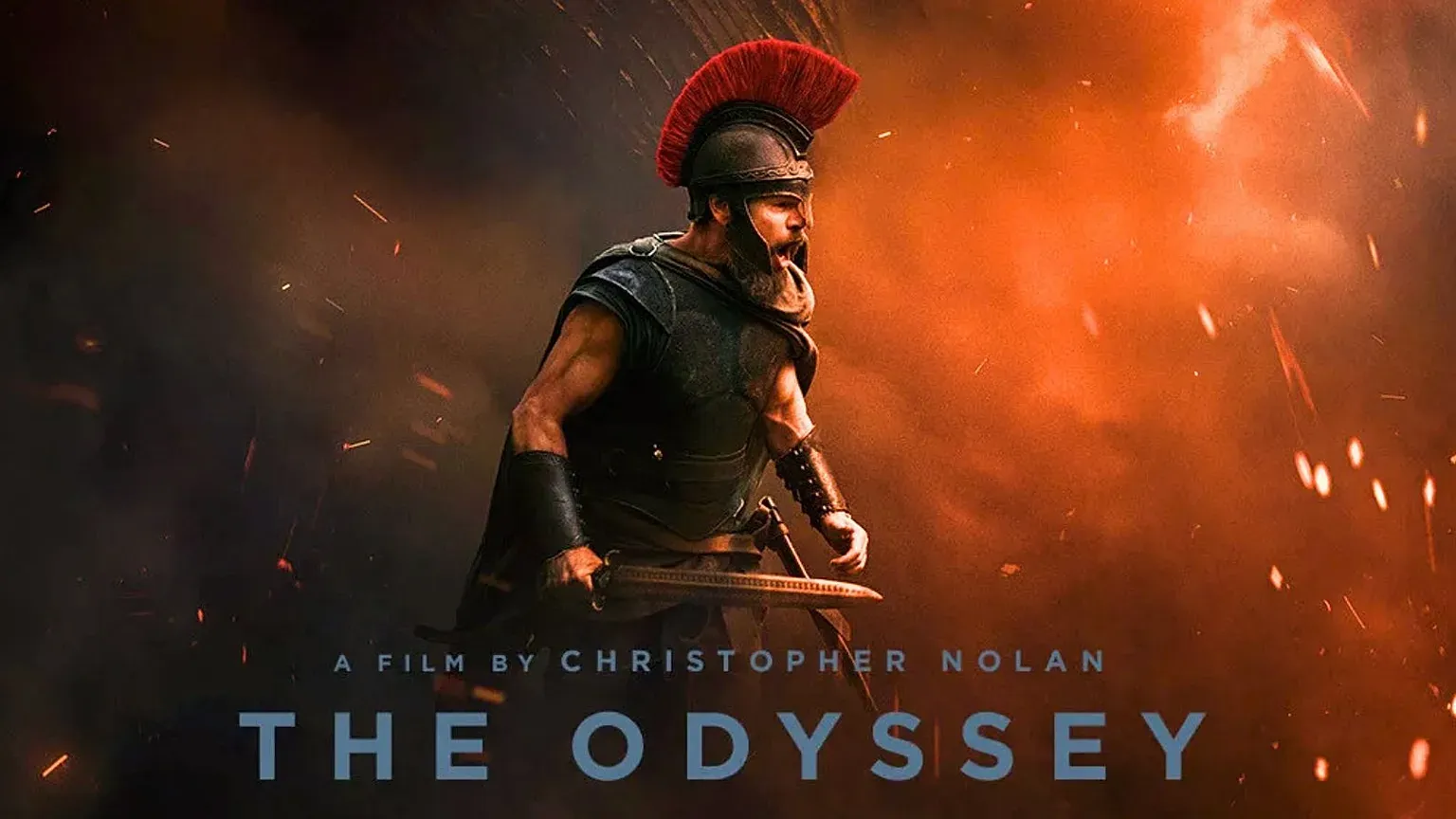
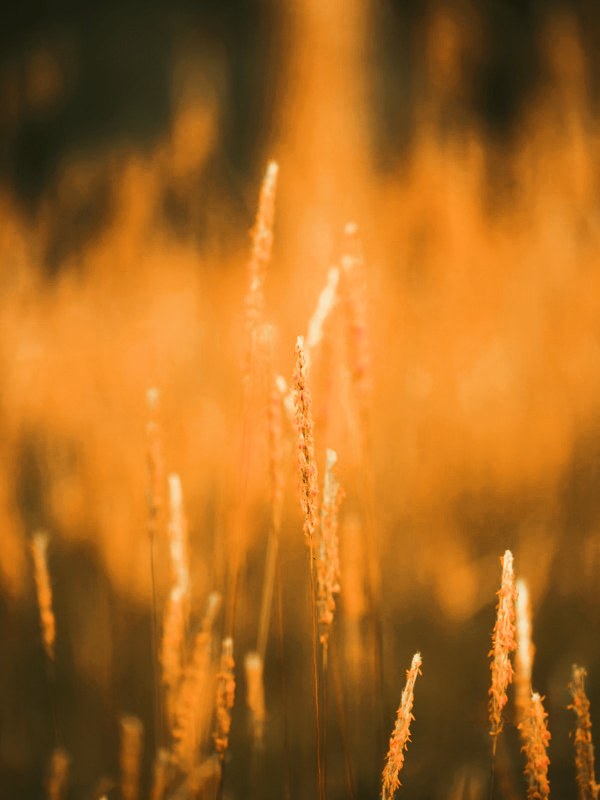
Fire, smoke and flying embers in The Odyssey style key art. Orange highlights against near-black smoke is the same warm and dark mix the film uses at night.
Nolan and van Hoytema, fifth time round
The Odyssey was written and directed by Christopher Nolan and shot by Hoyte van Hoytema, who also shot Interstellar, Dunkirk, Tenet and Oppenheimer for him and won the Oscar for Oppenheimer. Matt Damon plays Odysseus, with Anne Hathaway as Penelope, Tom Holland as Telemachus, Zendaya as Athena, Robert Pattinson as Antinous, Charlize Theron as Circe and Lupita Nyong'o in the ensemble. Van Hoytema operated the camera himself for most of the shoot.
Every frame on IMAX film
It's the first feature shot entirely with IMAX 15-perf 65mm film cameras, including a new, quieter IMAX camera built for the production. Some dialogue scenes were shot in 5-perf 65mm. The team exposed over two million feet of Kodak negative across 91 shooting days.
Two stocks, one look
Van Hoytema kept the stock choice simple: Kodak VISION3 250D for daylight exteriors and brighter interiors, and VISION3 500T for night and low light. He calls the pair his sweet spot. Those two emulsions, with their grain and the way they roll off highlights, are the core of the look.
Timed in the lab, not built in software
The final color was set by photochemical color timing at FotoKem in Burbank, where the negative was processed. The digital version you see in most cinemas was then matched to a projected film print by FotoKem colorist Kostas Theodosiou. Van Hoytema has said he prefers it that way because it forces decisions on set and leaves less to fix later.
Firelight without fire
For night scenes like the sack of Troy, the crew built domes of LED tiles that recreate the color and random flicker of real flames. That let the camera move all the way around the action while the light still behaved like fire.
Real places
The film was shot on location in Morocco, Greece, Italy, Scotland and Iceland, with soundstages in California for what couldn't be done outdoors. Natural light on real coastlines, plus restrained lens choices (mostly 50mm and 80mm on IMAX), gives the film its grounded feel.
Scene by scene
The key looks in The Odyssey.
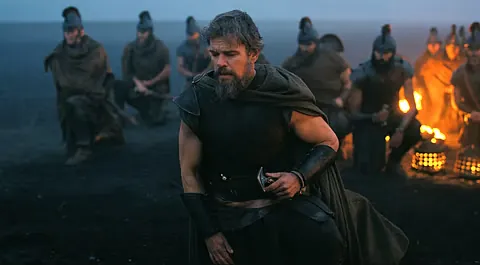
Odysseus and his men at dusk. A cool slate sky against warm fire baskets, The contrast comes from the light sources on set, and the grade leaves it alone. Image: Universal Pictures.
Daylight marches and battles
Exteriors like the forest march with Odysseus and his men are soft and desaturated, with grey-green haze, wet cloaks and dull bronze. Natural light does the work and the color stays restrained.
Firelit halls and interiors
Interiors such as Antinous among the suitors are lit by fire alone. Skin goes amber, metal turns gold and the background falls into near black, which is the classic look of tungsten-balanced 500T film under warm light.
Camps at dusk
Shore scenes at the end of the day mix a cool slate sky with the orange glow of fire baskets. It's a natural warm and cool split, created by the light sources on set.
The sack of Troy
The night battle was lit with domes of LED tiles that imitate the color and flicker of real flames, so the fire light moves across faces and armor as the camera circles the action.
Sea and coastline
Much of the voyage was shot on real coastlines in Greece, Italy, Morocco and Scotland. The sea and skies look the way film sees daylight: clean, slightly soft and never oversaturated.
Get the look
How to get The Odyssey look with a free LUT.
The Odyssey look comes from large format film, real light and a lab grade. A LUT can't add IMAX resolution, but it can give digital footage the soft highlights, natural color and gentle contrast of a film print, which is most of what makes the film feel the way it does.
Free starting point
Cinematic LUT (VEL_Cinematic_Teal.cube)
The best base. It adds gentle filmic contrast and keeps skin and landscapes natural, close to how a timed film print looks.
Film handles bright skies gracefully, and digital doesn't. Protect your highlights when you shoot, then lift the shadows a little in the grade.
2. Apply Cinematic at 40 to 60%
Keep it gentle. A timed print looks natural first and stylized second, so a strong LUT works against this look.
3. Roll off the highlights
Pull the top of the curve down slightly so skies and sun-lit skin fade softly into white. That smooth shoulder is one of the clearest signs of film.
4. Keep color natural
Avoid teal and orange splits and push nothing to neon. Correct white balance per scene so daylight looks like daylight and firelight looks like fire.
5. Add fine grain
Add a light, fine film grain over the whole edit. It hides digital sharpness and ties shots together the way the 250D and 500T grain does in the film.
6. For night scenes, use warm practical light
Light night scenes with warm, flickering sources and let the rest fall into darkness. Grade gently and keep detail in the shadows.
Shooting for the large format film look.
Use natural light where you can
Shoot exteriors in real sun at the right time of day. Most of the look of The Odyssey is light falling on real places.
Stay on normal focal lengths
Van Hoytema mostly used 50mm and 80mm equivalents and avoided extreme wides and long lenses. Normal lenses keep faces and landscapes looking natural.
Get close for faces
Large format makes close-ups feel intimate. For emotional moments, move the camera physically close to the actor. A zoom flattens the face and loses that feeling.
Make your light flicker
For fire and night scenes, use a flicker effect on an LED or a real flame source off camera. Moving light reads as fire far better than a steady warm lamp.
✦ Master Grade LUT Collection
Shooting digital but want film?
The Odyssey gets its look from IMAX film and a lab print, and no single LUT can copy that. The Master Grade Collection has Film and Hollywood categories built around print-style color and soft highlights, plus Dramatic and Atmospheric looks for firelit nights and hazy daylight.
The final color was set by photochemical color timing at FotoKem, and the digital release was matched to a projected film print by colorist Kostas Theodosiou. Most of the look comes from the Kodak film stocks and the lab process.
What film stock was The Odyssey shot on?
Kodak VISION3 250D 5207 for daylight and brighter interiors, and VISION3 500T 5219 for night and low light, all on 65mm in IMAX 15-perf format.
Who was the cinematographer of The Odyssey?
Hoyte van Hoytema, Christopher Nolan's director of photography since Interstellar, who won the Oscar for Oppenheimer.
Was The Odyssey shot entirely in IMAX?
Yes. It's the first feature shot entirely with IMAX film cameras, with some dialogue scenes in 5-perf 65mm. The production exposed more than two million feet of film.
Is there a free The Odyssey LUT?
There's no official LUT. The closest free starting point is the Cinematic LUT at 40 to 60%, with soft highlights and fine grain added as described above.
Where was The Odyssey filmed?
On location in Morocco, Greece, Italy, Scotland and Iceland, with additional scenes on soundstages in California.
This guide describes the look of The Odyssey for educational purposes. VideoEditingLUTs isn't affiliated with or endorsed by Christopher Nolan, Universal Pictures or the filmmakers. The free LUTs we recommend here are our own general looks, and none of them were made from the film itself.
Free Download
12 free LUTs. Every look covered.
Professional .cube files. Free, no credit card. Browse every style: